
Last updated October 16, 2026
 Wrought iron
 Farm & ranch
 Sliding driveway gates
 LiftMaster operators
Free on-site gate assessment - hinges, posts, and your LiftMaster or Nice gate operator checked before anything is quoted
The assessment is free and the quote is the invoice.
Get your free estimateSeasonal Gate Repair Care for Henderson: Year-Round Homeowner’s Guide
Henderson’s monsoon season runs July through September, which means the worst electrical storms hit gate control boards right after the hottest months have already stressed them to their limits. The failure spike we see every August isn’t bad luck. It’s a predictable result of ignoring two separate seasonal threats in sequence: heat that cooks internal components, then lightning and surge damage that finishes the job. This guide lays out the actual maintenance windows Henderson’s climate demands, not the generic twice-a-year schedule that works for coastal cities. For a deeper dive, see our Complete Guide to Gate Repair in Henderson. You’ll learn what to check before June, how to prep for monsoon electrical activity, why mild winters still damage gate motors, and the October inspection that catches damage before it compounds.
Styles & brands we work with
Quick Answer
Seasonal gate care in Henderson means four specific maintenance windows, not two: a pre-summer check in May before temperatures cross 100°F, monsoon preparation in late June before July storms, a winter condensation inspection in December, and a post-summer damage assessment every October. Each window targets distinct failure modes tied to Henderson’s climate: motor overheating, surge damage, internal moisture, and UV degradation. Skipping any one of them shortens the life of your gate motor by years, not months.
Table of Contents
- The Pre-Summer Checklist: What to Do Before Temperatures Cross 100°F
- Monsoon Prep: Surge Protection, Drainage, and Control Board Weatherproofing
- Why UV Exposure at Henderson’s Elevation Kills Gate Components on an 18-Month Cycle
- Henderson’s Mild Winter Is Still a Condensation Threat to Gate Motors
- The Post-Summer Inspection: Why October Is Henderson’s Most Important Gate Maintenance Month
- Lubricant Replacement: Henderson’s Heat Demands a Different Schedule
- Battery Condition: The Backup Power Component Most Homeowners Forget
- Common Mistakes to Avoid
- When to Call a Professional
- Frequently Asked Questions
- The Bottom Line
The Pre-Summer Checklist: What to Do Before Temperatures Cross 100°F
By late May, Henderson’s daytime highs start pressing into the upper 90s, and by mid-June, 100°F becomes a regular occurrence. Your gate motor sits inside a metal or plastic housing that absorbs direct sunlight all day. The internal temperature can run 30 to 40 degrees hotter than the outside air. A 105°F day means a 135°F to 145°F environment inside the motor housing. That’s the number that matters, because heat is what degrades capacitors, solder joints, and winding insulation in every gate motor brand we service.
Here’s the pre-summer checklist that matters in Henderson, in order of importance:
- Ventilation check. Remove debris, spider webs, and dust from any vent openings on the motor housing. Blocked vents are the number one cause of August motor failures in Henderson. A motor that can’t shed heat builds internal resistance, draws more current, and fails sooner.
- Capacitor inspection. The start capacitor is the first component to fail under sustained heat. If your gate hesitates on startup or the motor hums before moving, the capacitor is already weakened. Replace it before summer, not after it fails in July.
- Lubricant assessment. Grease that worked fine in March breaks down by June. Heat thins lubricant, causing it to run off hinge pins and rail tracks. What’s left behind is a sticky residue that attracts dust and grit. Section on lubricant replacement below covers this in detail.
- Chain and belt tension. Heat expands metal. A chain that was properly tensioned in winter will be looser in June. Loose chains slip on sprockets, which wears teeth and creates jerky gate movement. Check tension while the gate is closed, not mid-cycle.
- Safety sensor alignment. UV glare and heat shimmer off Henderson’s pavement can cause photo-eye sensors to false-trigger in summer. Clean lenses with a dry cloth and confirm alignment before the heat wave starts.
We’ve replaced enough gate motors in Green Valley Ranch and Anthem to know this pattern well: the call comes in August, the motor is two to five years old, and the homeowner never opened the housing once. Heat doesn’t kill motors in a day. It takes weeks of daily stress to cook the components. The May checklist costs an hour. A new gate motor costs $600 to $1,400 installed, depending on brand and swing versus slide configuration. Our Gate Repair team can help you avoid that expense with proper seasonal care.
Monsoon Prep: Surge Protection, Drainage, and Control Board Weatherproofing
Henderson’s monsoon pattern is different from Phoenix’s. We get fewer storms, but when they arrive, they arrive hard. July through September brings afternoon storms with cloud-to-ground lightning strikes across the valley. Every strike within two miles of your home sends a voltage spike through the power grid that can reach your gate control board through the main service line. Control boards in Henderson fail at a higher rate during monsoon months than any other time of year. The damage isn’t always immediate, either. A surge can weaken a board’s components and cause the board to fail weeks later, in October or November, when the homeowner assumes it’s unrelated.
Here’s what Henderson homeowners should do before the first July storm:
- Install or verify a dedicated surge protector on the gate’s power supply. A whole-house surge protector helps, but a dedicated surge device at the gate motor’s disconnect box provides direct protection. These cost $40 to $120 for the part, plus installation if you’re not comfortable working with electrical connections.
- Inspect the control board housing gasket. The rubber gasket around the control board enclosure degrades under Henderson’s UV exposure. A cracked or flattened gasket lets moisture in during heavy rain, which is how boards short out mid-storm. Run a finger along the gasket. If it feels stiff, cracked, or doesn’t spring back, replace it.
- Check drainage around gate posts. Henderson’s hard-packed desert soil doesn’t absorb water quickly. After a monsoon downpour, water can pool around gate post bases and hinge posts. Standing water seeps into post footings, causing rust and misalignment over time. Confirm that soil slopes away from the posts on all sides, not toward them.
- Clear gutters and drainage channels near the gate track. Slide gates sit close to the ground. If runoff channels silt and debris toward the track, the gate is dragging through standing water after every storm. This stresses rollers, wears the track, and adds load to the motor.
- Test the manual release mechanism. If a storm knocks out power, you need to know how to open the gate manually. The release mechanism should operate smoothly with one hand. Stiff releases mean the mechanism needs cleaning and lubrication before you actually need it.
Lightning protection for gate motors isn’t a luxury in Henderson. It’s the same logic as flood insurance: you hope you never use it, but the cost of not having it is catastrophic. A control board replacement runs $200 to $650 for most brands, not including labor. A surge protector costs a fraction of that.
Why UV Exposure at Henderson’s Elevation Kills Gate Components on an 18-Month Cycle
Henderson sits at roughly 1,900 to 2,400 feet above sea level, depending on your neighborhood. That elevation means thinner atmosphere and higher UV intensity than sea-level cities like Los Angeles or San Diego. UV radiation at Henderson’s elevation is roughly 15 to 20 percent more intense than at sea level, and it works on gate components year-round, not just in summer.
The measurable damage follows a pattern:
- Rubber seals and gaskets: UV destroys the polymer bonds in rubber. Gate motor housing gaskets, hinge seals, and wheel bearings with rubber components become stiff and cracked within 18 months of constant exposure. Once cracked, they stop sealing, and dust, moisture, and insects get inside.
- Wiring insulation: Exposed low-voltage wiring from the gate to the house or from the motor to safety sensors degrades under direct sun. Insulation becomes brittle, develops hairline cracks, and eventually exposes conductors. Short circuits and intermittent faults follow.
- Painted surfaces: Gate frame paint and powder coating fade and chalk under Henderson’s UV. More importantly, exposed metal from chips and scratches begins rusting, and surface rust spreads underneath otherwise intact paint.
- Plastic components: Control board enclosures, photo-eye housings, and remote control casings all weaken under UV. Plastic becomes yellowed and brittle, then cracks from normal thermal expansion and contraction.
The 18-month figure isn’t arbitrary. It’s how long these components typically last in direct Henderson sun before functional degradation starts. Shaded gates last longer. Gates on north-facing lots degrade more slowly. Gates in full southern exposure through the afternoon need seal and gasket replacement on roughly that 18-month schedule. If your gate was installed more than two years ago and the seals have never been replaced, they’re already failed or close to it.
One specific issue we see regularly on LiftMaster and Mighty Mule systems in Henderson: the plastic cover over the limit switch adjustment screws becomes so brittle from UV that it shatters when a technician tries to remove it. That’s a $15 part, but it means the difference between a 10-minute adjustment and a control board replacement if the broken plastic falls into the wrong place.
Henderson’s Mild Winter Is Still a Condensation Threat to Gate Motors
Henderson’s winter daytime temperatures hover in the 50s and 60s, with overnight lows dipping into the 30s. Homeowners assume that’s nothing to worry about compared to places with snow and ice. The gate doesn’t care about snow. The gate cares about temperature swings and the condensation they create.
Here’s the mechanism: during the day, the motor housing warms up to 60°F or 70°F. At night, it drops to 35°F or lower. Warm air holds moisture. When the air inside the motor housing cools, that moisture condenses on metal surfaces: the motor windings, the control board, the capacitor terminals, the limit switch contacts. This happens every single night during Henderson’s winter.
The result is a thin film of water inside the motor housing, night after night, for months. Water on a control board causes corrosion on solder joints. Water on limit switch contacts causes intermittent false readings. Water inside the motor itself degrades winding insulation and leads to ground faults. None of this is dramatic. It’s slow, cumulative, and invisible until the gate stops working.
The fix is simpler than most homeowners expect:
- Verify the housing breather drain is clear. Many gate motor housings have a small drain hole or breather at the bottom. If it’s blocked with dust or insects, condensation has nowhere to go. Clear it with a small wire or compressed air.
- Replace worn housing gaskets before winter. A housing that seals properly during the day, when warm air is expanding, keeps dry air in. A housing with failed gaskets lets in humid afternoon air that condenses at night.
- Apply dielectric grease to electrical connections. Dielectric grease is a non-conductive compound that displaces moisture. Applying it to spade connectors and screw terminals inside the control board housing prevents the corrosion that winter condensation causes. It’s a $8 tube that saves a $400 board.
- Check for signs of existing moisture damage. White or green corrosion on terminals, rust on the motor housing interior, or a musty smell when you open the enclosure are all signs condensation has been doing damage. Address them before the damage spreads.
Henderson’s winter doesn’t freeze gates like northern climates. It corrodes them slowly, and because the failure happens in March or April, homeowners rarely connect it back to three months of nightly condensation.
The Post-Summer Inspection: Why October Is Henderson’s Most Important Gate Maintenance Month
By October, Henderson’s gate has survived the two worst threats of the year: three months of extreme heat and three months of monsoon electrical activity. The damage from those seasons doesn’t always show itself on schedule. A heat-stressed capacitor might limp through September and fail in November. A surge-weakened control board can work fine for six weeks after the last storm, then fail on the first cold morning when the solder joints contract.
The October inspection is the single highest-value maintenance hour a Henderson homeowner can spend on their gate. Here’s why: the damage already exists. The October inspection finds it while the weather is still mild, before a failure strands your car inside or outside the property, and before compounding damage turns a $150 repair into a $900 replacement.
The October inspection checklist:
- Listen to the gate run a full cycle in both directions. Heat damage shows up as a grinding noise, a hesitation, or a faster-than-normal run. Any change from spring operation is worth investigating.
- Inspect the control board for visible signs of surge damage. Look for scorched spots, swollen capacitors, or a burnt electrical smell inside the housing. Monsoon surge damage is often visible if you know what to look for.
- Check all bolts, hinges, and mounting brackets for looseness. Heat expansion and contraction over four months loosens fasteners. A loose hinge bolt on a swing gate changes the gate’s weight distribution and strains the motor.
- Test the safety sensors and auto-reverse function. Block the photo-eye beam with a solid object and confirm the gate stops and reverses. This is a safety function, not an optional feature, and it needs to work every time.
- Examine the gate track for debris, sand, and wear. Monsoon runoff carries silt and sand onto slide gate tracks. Clean the track thoroughly and inspect rollers for flat spots or wobble.
- Check the gate’s ground clearance and alignment. Soil shifts from heavy rain can cause posts to settle slightly. A gate that was perfectly level in June might be dragging by October.
October is also the right time to schedule any repairs that you know are coming. Waiting until the gate fails during a holiday weekend means emergency rates and a longer wait. Scheduling the repair in October means your pick of appointment times and no pressure. If you’re in Henderson and want a second set of eyes on the post-summer inspection, our technicians at Carver Gate Repair Henderson do this every day for homeowners across the valley.
Lubricant Replacement: Henderson’s Heat Demands a Different Schedule
Lubricant advice for gates that you’ll find online is mostly written for temperate climates. The standard recommendation of “lubricate every six months” falls apart in Henderson, because our heat destroys lubricant faster than the schedule assumes. Grease that’s rated for six months in 75°F weather lasts about four months in a Henderson summer.
What happens is straightforward: heat thins the lubricant’s base oil, causing it to separate from the thickening agent. The oil runs off, leaving behind a sticky, non-lubricating residue that attracts fine desert dust. The result is a paste that actually increases friction rather than reducing it. Hinge pins, rail tracks, and chain sprockets operate under this paste-like compound for months, and the homeowner assumes the gate is lubricated because they applied something six months ago.
For Henderson, here’s the schedule that actually works:
- Hinge pins on swing gates: Clean and re-lubricate every 3 months during the heat season (May through September). Use a white lithium grease or a synthetic multi-purpose grease rated for high temperatures.
- Slide gate tracks: Clean and apply a light layer of silicone-based lubricant every 2 months during the heat season. Desert dust accumulates fast, and the track collects it directly.
- Chain drives: Apply chain-specific lubricant every 3 months, regardless of season. Chains run constantly and the links need consistent film coverage.
- Wheel bearings and rollers: Sealed bearings don’t need lubrication and shouldn’t be opened. Unsealed bearings should be packed with grease annually, ideally in the fall before the mild season.
- Limit switch mechanisms: Do not lubricate limit switches. Lubricant attracts dust, and dust on limit switch contacts causes false readings. Clean them with a dry brush or compressed air only.
One more Henderson-specific note: the fine dust that blows in from the desert is abrasive. It’s not just that lubricant breaks down faster in the heat, it’s that the replacement residue mixes with silica dust and becomes a grinding compound. That’s the real reason the schedule matters. A poorly lubricated gate in a dusty city fails faster than the same gate in a humid climate with cleaner air.
Battery Condition: The Backup Power Component Most Homeowners Forget
Gate motors with battery backup systems are common in Henderson, especially in gated communities and homes with slide gates on the main entrance. The battery’s job is to keep the gate operational during a power outage. What most homeowners don’t realize is that heat destroys batteries just as effectively as cold does, and a battery that hasn’t been checked since installation is probably already dead.
Here’s the problem in Henderson specifically: battery manufacturers rate battery life at 77°F. Every 15°F above that temperature cuts battery life in half. A battery sitting inside a gate motor housing that reaches 130°F in July is aging at roughly four times the rated speed. A battery rated for 4 years in ideal conditions lasts about 1 year in a Henderson gate motor housing that gets direct afternoon sun.
The seasonal battery check that applies to Henderson:
- Test the battery every May, before the heat arrives. A load test is the only reliable way to know battery condition. A simple voltage reading doesn’t tell you whether the battery can actually deliver current under load.
- Check for swelling or leakage. Heat causes sealed lead-acid batteries to swell. A swollen battery doesn’t fit the housing properly and can leak acid, which corrodes the control board below it.
- Clean the terminals. Corrosion builds on battery terminals in heat, even in sealed housings. Clean terminals with a wire brush and apply a thin coat of dielectric grease.
- Plan for replacement every 2 to 3 years in Henderson, not the 4 to 5 years manufacturers claim. The heat penalty is real. If your battery has been in place for three summers, it’s approaching the end of its useful life.
- Test the system after battery replacement. Disconnect main power and confirm the gate opens and closes on battery power alone. A battery that doesn’t actually power the gate is no better than no battery.
Battery backup systems on gate motors are not optional safety equipment for many Henderson homeowners. If your gate is the only vehicle access point to the property, a dead backup battery means you’re manually releasing the gate during every power outage. For most people, that’s worth a $100 to $200 battery replacement every few years.
Common Mistakes to Avoid
- Treating gate maintenance as a one-time annual task. Henderson’s climate doesn’t work on a calendar-year schedule. The gate needs four seasonal checks: May, late June, October, and December. Doing one annual tune-up in spring means missing monsoon prep and post-summer damage assessment.
- Ignoring ventilation because the motor “still works.” A motor with blocked vents works fine right up until it doesn’t. The failure happens in August, after weeks of accumulated heat stress. The ventilation check in May is preventive; the repair in August is not.
- Using WD-40 as a gate lubricant. WD-40 is a solvent and water displacer, not a lubricant. It strips existing grease and leaves a thin film that evaporates quickly. Henderson’s dusty conditions require actual grease or silicone lubricant, not aerosol solvents.
- Assuming a whole-house surge protector covers the gate. Whole-house surge protection is helpful, but the surge that kills a gate control board often comes from induced current on the low-voltage wiring from the keypad, intercom, or loop detector. A dedicated surge device at the gate’s disconnect is the correct protection.
- Deferring a control board replacement because it’s “too expensive.” A control board that’s been surge-damaged but still works will eventually fail completely. The failure rarely happens at a convenient time. Replacing it in October costs the same as replacing it in August, but the October replacement is scheduled, not an emergency.
- Never testing the manual release mechanism. If the first time you use the manual release is during a power outage at night, you’re going to struggle with it. The mechanism needs to be tested, cleaned, and lubricated periodically, just like every other moving part.
- Skipping the drainage check because “it doesn’t flood in Henderson.” Monsoon rain in Henderson comes hard and fast, and the soil doesn’t absorb it quickly. Standing water around gate posts and tracks is common during July and August storms. Checking drainage before monsoon season costs nothing.
When to Call a Professional
Some seasonal maintenance tasks are homeowner-friendly: cleaning tracks, checking vents, testing the manual release. Others are not. If you’re unsure which category your issue falls into, our DIY vs Professional Gate Repair guide can help you decide. If you smell burning plastic from the motor housing, that’s an electrical fault that needs a technician. If the gate makes a grinding noise, that’s a mechanical issue that’s already damaging something. If the control board shows scorch marks or swollen capacitors, that’s surge damage that requires diagnosis and possibly replacement. If the gate hesitates on startup or trips a breaker, stop using it and get it checked.
High-voltage electrical work, spring tension adjustments, and anything involving the gate’s structural posts should be left to someone who works on gates daily. Gate springs under tension can cause serious injury if handled improperly. If you’re not sure whether a task is safe, call a professional. Carver Gate Repair Henderson offers free estimates in Henderson – call (775) 307-6571 and a live person will answer, any day of the year.
Frequently Asked Questions
A basic seasonal inspection and tune-up in Henderson typically costs $75 to $150 depending on the gate type and the number of components being serviced. More involved work, like control board replacement or motor swap with gate motor repair in Henderson, runs $300 to $1,400 depending on brand and configuration. The inspection fee is always quoted before any work starts, and you approve it before the technician begins. Call (775) 307-6571 for a free estimate specific to your gate.
For repair calls, yes – our technicians in Henderson can usually reach you the same day or within 24 hours for emergency issues like a gate that won’t open or a motor that has failed. Installation and replacement work is scheduled for a measured appointment with a written price. Call (775) 307-6571 and a live person will tell you what’s available today.
Yes, if your gate motor is powered by the main electrical service, Henderson’s monsoon lightning storms create real surge risk for control boards. A dedicated surge protector at the gate’s disconnect box costs $40 to $120 for the part and protects a $200 to $650 control board. The math favors protection.
Hinge pins on swing gates need cleaning and re-lubrication every 3 months during the heat season, May through September. Slide gate tracks need attention every 2 months during that same period because Henderson’s fine dust mixes with degraded lubricant to create abrasive paste. Chains need lubrication every 3 months year-round.
Motor failure from heat stress is the most common August call in Henderson. Blocked ventilation, degraded capacitors, and thinned lubricant combine over weeks of 100°F-plus heat, and the motor gives out, usually during the hottest part of the day. The May checklist prevents most of these failures. Call (775) 307-6571 if your gate is already showing signs of heat stress.
Our Henderson technicians work on nine gate-motor brands including LiftMaster, FAAC, BFT, Mighty Mule, and five others. We match the parts and the programming to the system already installed at your home. If you’re not sure what brand your motor is, we identify it during the estimate. Carver Gate Repair Henderson covers repair, replacement, and new gate installation in Henderson.
The Bottom Line
Henderson’s climate doesn’t offer a gentle season for gate systems. The heat cooks motors and batteries. The monsoons surge control boards and flood tracks. The UV radiation at our elevation destroys seals and wiring on an 18-month cycle. Even the mild winter creates nightly condensation that corrodes electrical connections. The gate systems that last in this city are the ones that get checked in May, prepped in June, inspected in October, and sealed in December. The gate systems that fail are the ones that get ignored until the gate stops moving. Your gate gives you warning signs for months before it fails. Pay attention to them, and you’ll replace a $15 seal instead of a $900 motor.
Written by Lonnie Burke, Owner at Carver Gate Repair Henderson, serving Henderson since 2008.
See the difference
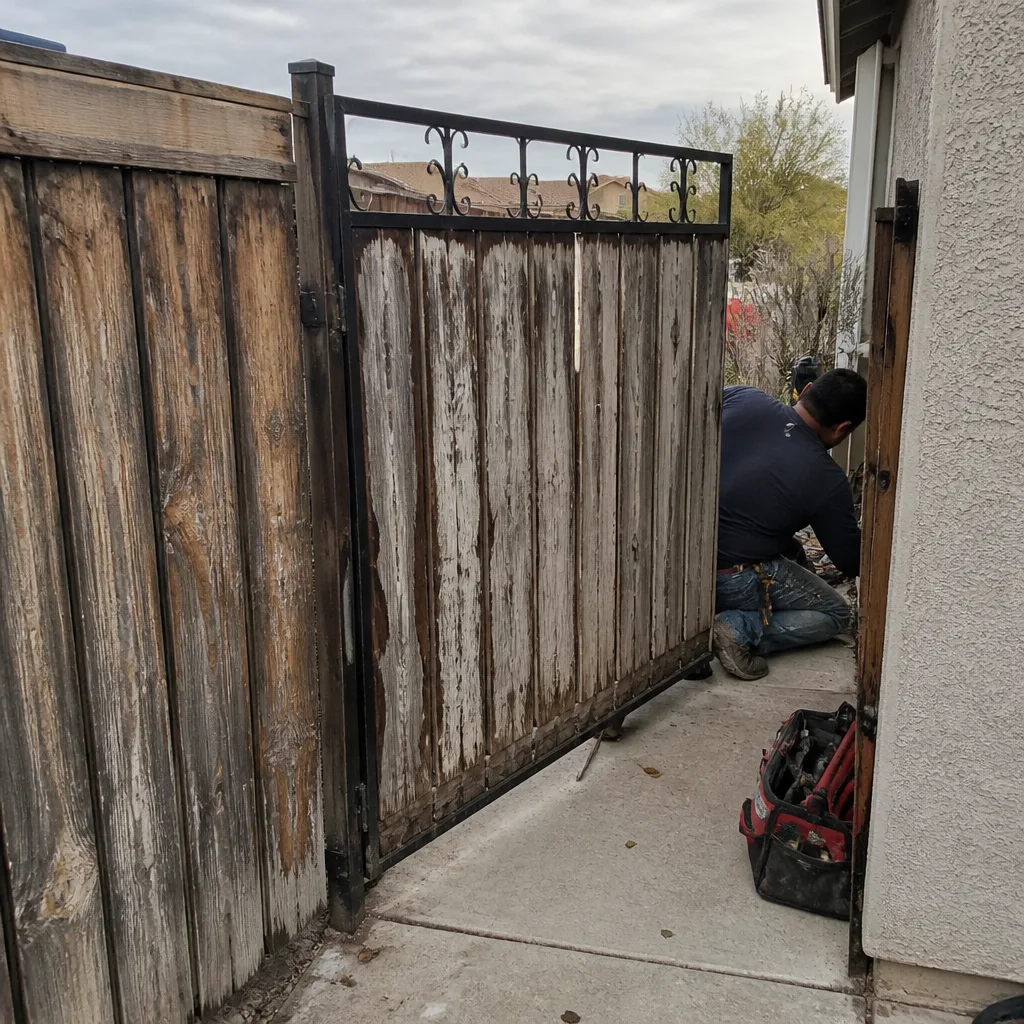 Before
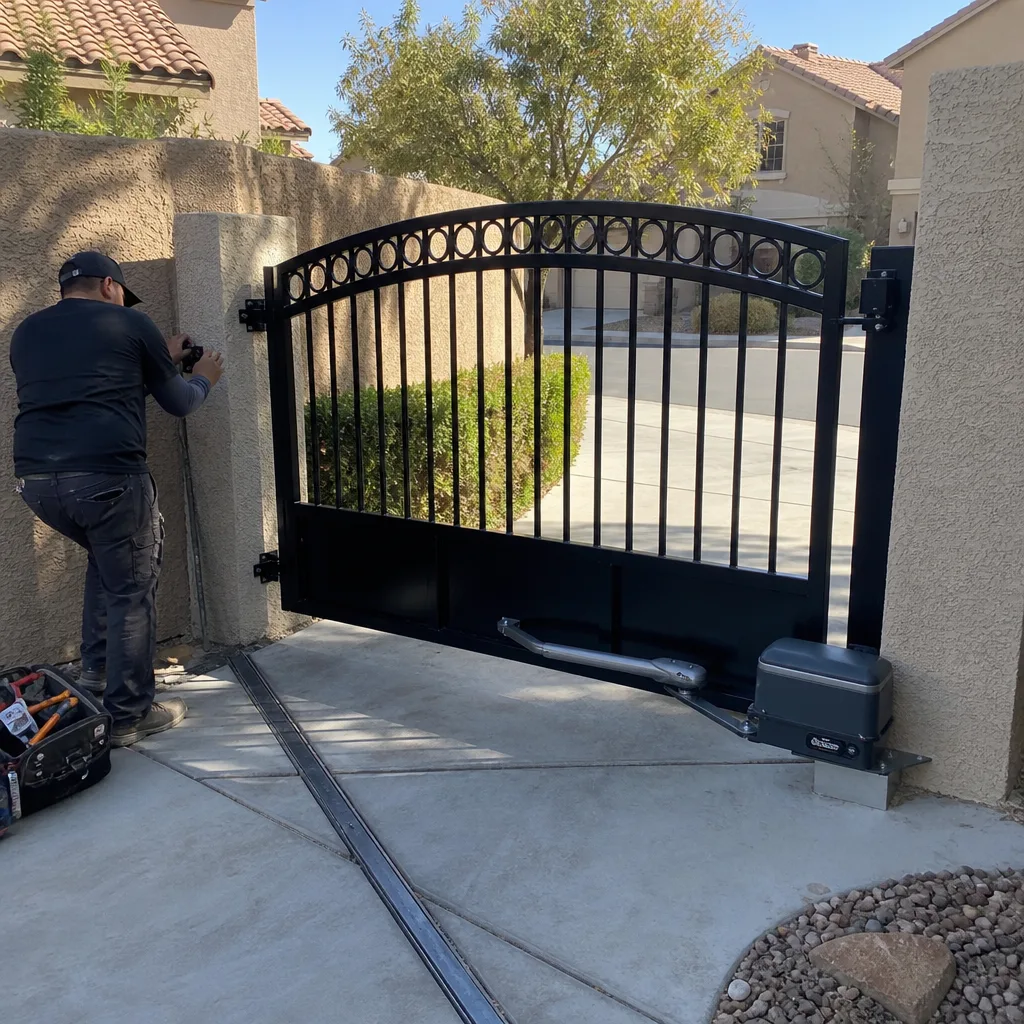
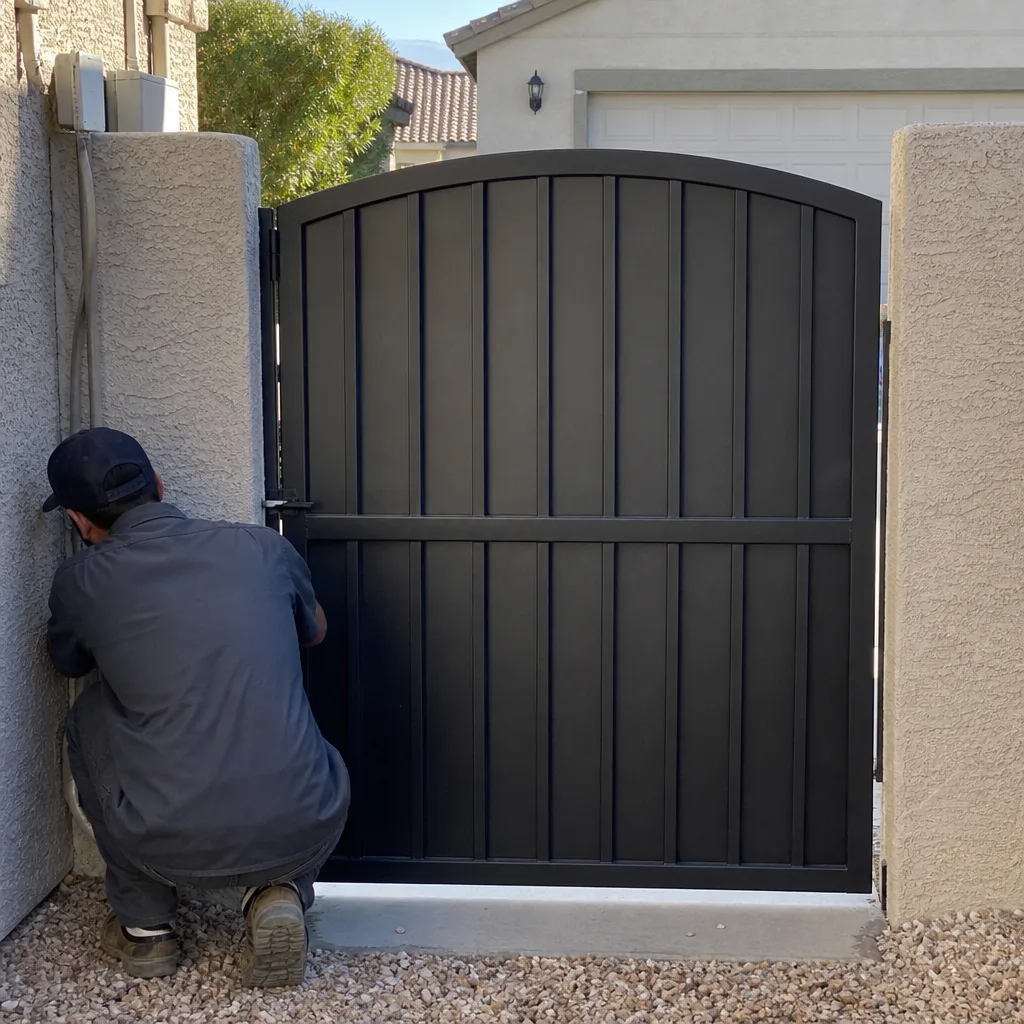 After
After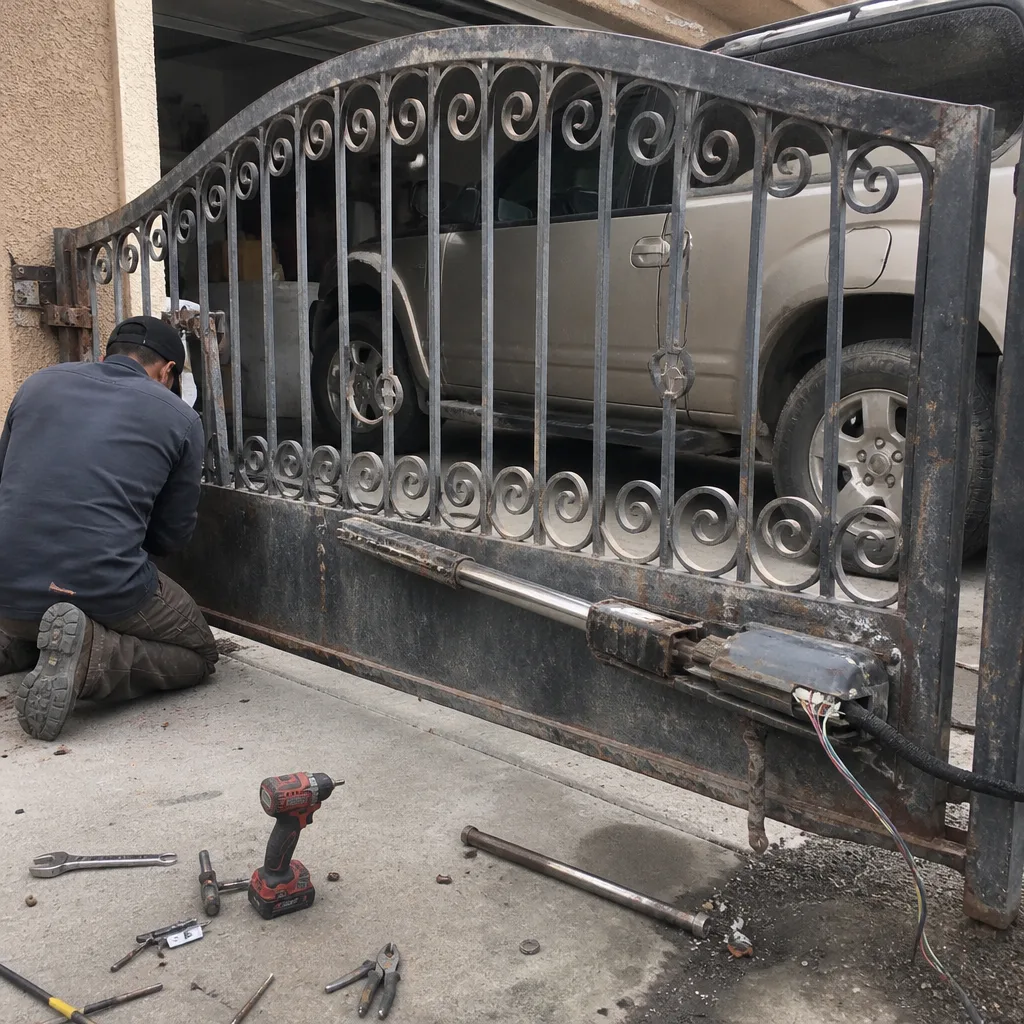 Before
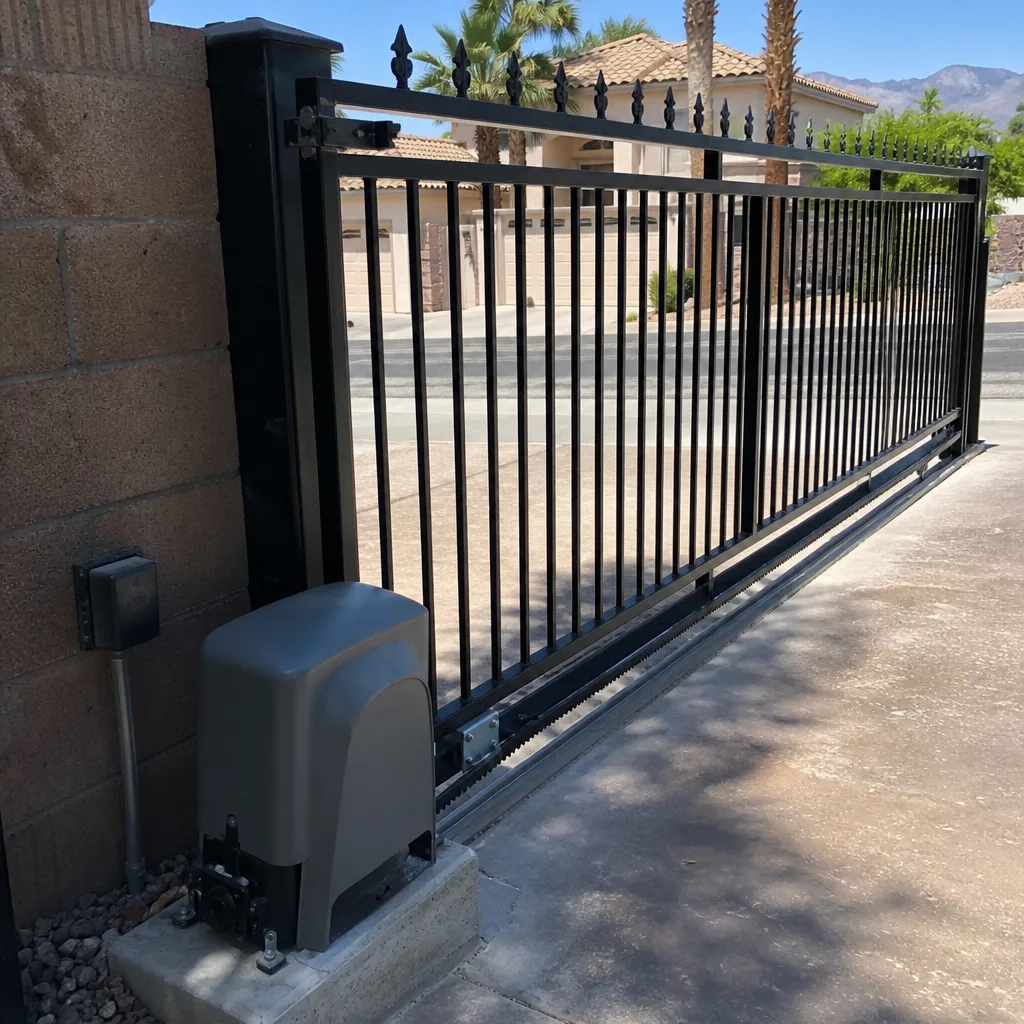 After
After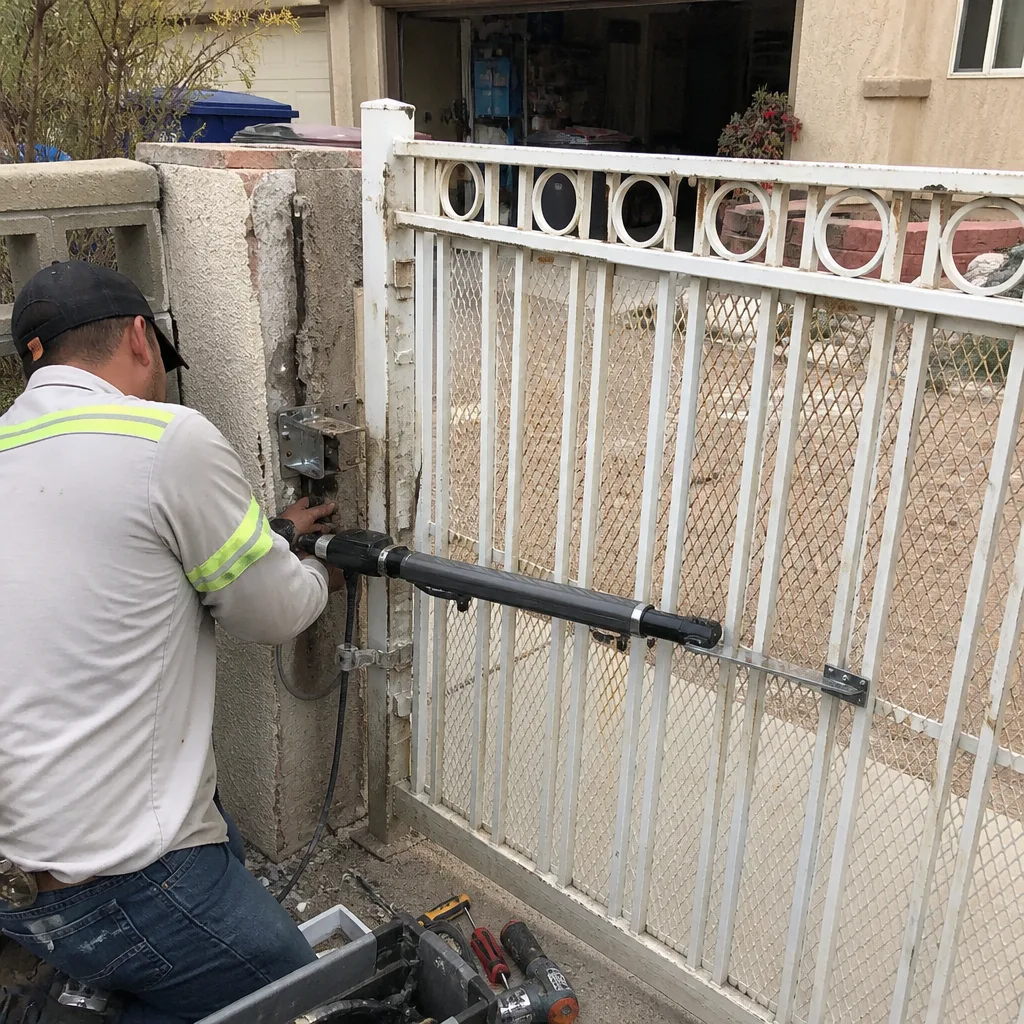 Before
 After
After